My research interests lie mainly in
Geophysical Fluid Dynamics. I try to combine
theoretical approaches, numerical simulations and observations
to better understand phenomena that matter for atmospheric circulation,
typically on mesoscales, tens to hundreds of kilometers. My main
areas of interest are gravity waves, the Upper Troposphere Lower Stratosphere
(UTLS) region, cirrus clouds, and atmosphere-ocean interactions on small scales.
Gravity Waves
 Internal gravity waves are waves occuring in the interior of a
stratified fluid, the restoring force being due to buoyancy. These
waves are typically small-scale features of the flow (10-1000km in the
horizontal). A lot can be understood of atmospheric and oceanic
dynamics without taking them into account (i.e. using balanced
approximations such as the quasi-geostrophic on). Yet, there are
aspects of both atmospheric and oceanic circulations which can not be
understood without considering gravity waves (e.g. the circulation of the
middle atmosphere and in particuar the mesosphere, the energy budget
in the ocean). At present, one essential challenge is to understand
and quantify the sources of these waves, in order to be able to
parameterize them in global models.
Internal gravity waves are waves occuring in the interior of a
stratified fluid, the restoring force being due to buoyancy. These
waves are typically small-scale features of the flow (10-1000km in the
horizontal). A lot can be understood of atmospheric and oceanic
dynamics without taking them into account (i.e. using balanced
approximations such as the quasi-geostrophic on). Yet, there are
aspects of both atmospheric and oceanic circulations which can not be
understood without considering gravity waves (e.g. the circulation of the
middle atmosphere and in particuar the mesosphere, the energy budget
in the ocean). At present, one essential challenge is to understand
and quantify the sources of these waves, in order to be able to
parameterize them in global models.
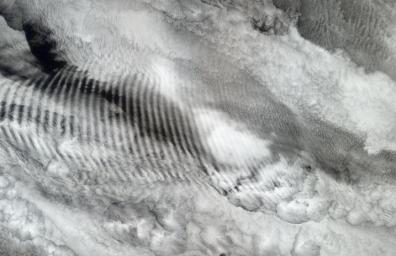
The above satellite picture comes from Nasa's Planetary
Photojournal. As in this example, gravity waves are sometimes
visible thanks to clouds, when water vapor saturates in the regions
where air is ascending due to the gravity wave present.
Ocean-Atmosphere interactions
As satellite observations allow a more global and more detailled
outlook on oceanic Sea-Surface Temperatures (SST) and surface winds,
it has come out that there were striking correlations at small
scales (of the order of 100 km) between variations of SST and
surface winds. The mechanisms are partially understood, but many issues
remain. In particular, the impacts for the free troposphere, the importance
of this connection, and the presence of similar correlations at yet shorter scales
remain issues of active research.
Other themes
Below are some other themes I have worked or still work on, rather i
intermittently for the first, more systematically for the last.
Symmetric and inertial instability
In the study of the geostrophic adjustment of jets, we have underlined
the key role of anticyclonic regions for trapping inertia-gravity
waves with frequencies lower than the inertial frequency. Inertial
instability appears as the unstable counterpart of these subinertial
waves when the anticyconic vorticity becomes lower than
-f. This instability, its selection of a vertical scale, its
nonlinear saturation and its impacts for mixing are not yet fully
understood.
Cheese fondue
The proper combination of cheeses to use for a cheese fondue remains a
matter of heatedd debates: emmenthal, comte, beaufort, appenzeller,
gruyere, abondance are of course all on the list, but are they all
necessary? In which proportions? The choice of the wine and the
addition of Kirsch are also a subject of numerous experiments, and for
which theory is still lacking. Finally, the status of alternative
fondues, involving cheeses like goat, roquefort or munster, or using
milk instead of white wine (for pregnant and breastfeeding mothers)
are further subjets of investigation.